What Is Circle Rate in Gurgaon? Complete Guide
- 08 Sep 2026

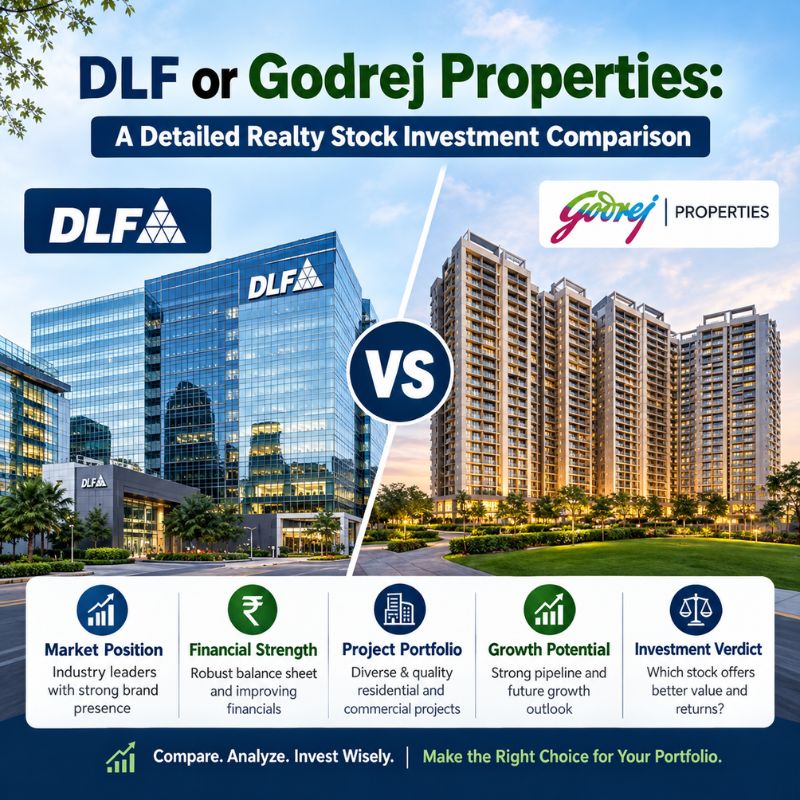
DLF and Godrej Properties are two of the most closely watched names in India’s listed real estate sector. Both have strong brands, premium residential projects and large development pipelines, but their business models and growth strategies are different.
The DLF vs Godrej Properties stock comparison has become more interesting after their latest quarterly performance. Godrej Properties delivered record sales bookings of around ₹8,651 crore in Q1 FY27, up 22% year over year. DLF, on the other hand, reported bookings of about ₹657 crore as several launches were deferred. However, DLF ended the quarter with a net cash position of approximately ₹15,200 crore, highlighting a major balance sheet advantage.
This creates a simple but important investment question: Should investors prefer Godrej Properties’ faster sales momentum or DLF’s stronger financial position and diversified real estate business?
The answer depends on what an investor values more: growth acceleration, financial strength, recurring income, geographical exposure or valuation.
| Factor | DLF | Godrej Properties |
| Core strength | Residential + commercial + rental | Residential development |
| Major markets | Gurugram, NCR, Mumbai and other cities | Mumbai, Bengaluru, NCR, Pune, Hyderabad and other cities |
| Q1 FY27 bookings | ~₹657 crore | ~₹8,651 crore |
| Recent booking momentum | Weak due to deferred launches | Strong |
| Balance sheet | Strong net cash | Net debt |
| Rental business | Major advantage | Limited |
| Development model | Development + annuity | Development focused |
| Project pipeline | Very large | Very large |
| Geographic diversification | Moderate | High |
| Current sales momentum | Lower | Higher |
| Financial strength | Higher | Lower |
| Growth profile | Balanced | Growth focused |
The table shows why neither company can be called an obvious winner without looking deeper into the numbers.
The DLF stock offers exposure to a business that is broader than residential property development. The company has residential projects as well as commercial and retail assets that generate recurring income.
Gurugram is one of DLF’s biggest competitive advantages. The company has a long-established presence in the market and has developed a strong portfolio of premium and luxury housing projects. The region also benefits from corporate offices, technology companies, financial services and high-income professionals.
DLF’s commercial portfolio adds another layer to the investment story. Its rental business provides recurring cash flow, making the company less dependent on residential project launches alone.
For investors looking at DLF or Godrej Properties, this diversification is one of the most important differences.
DLF ended Q1 FY27 with a net cash position of approximately ₹15,200 crore. This is a significant advantage in a capital-intensive industry where developers need substantial funds for land, construction and project development.
A strong cash position gives DLF more flexibility to fund projects without taking on excessive debt. It can also protect if property demand slows or project launches are delayed.
This does not automatically make the DLF share the better investment. However, it does reduce one of the major risks associated with real estate companies: excessive leverage.
DLF’s annuity business is another key differentiator. Its commercial portfolio covers around 50 million square feet and maintained approximately 95% occupancy during Q1 FY27.
The rental business gives DLF a recurring income stream alongside residential development. Three additional retail destinations with a combined gross leasable area of around 1.5 million square feet are also planned to become operational during the fiscal year.
For investors seeking a real estate company with both development growth and recurring income, this is a meaningful advantage.
The DLF future growth story depends heavily on its upcoming residential and commercial launches.
The company’s Q1 FY27 sales bookings were only around ₹657 crore, a sharp decline from the previous year’s ₹11,425 crore. However, the company attributed the decline mainly to deferred project launches rather than a complete collapse in customer demand.
This distinction is important.
Real estate presales can be highly uneven because a single luxury project can contribute thousands of crore to quarterly bookings. If a major launch is delayed, the booking value shifts into a later quarter.
DLF has maintained its FY27 sales target of around ₹20,000 crore and has a substantial launch pipeline across Gurugram, Mumbai and Goa.
If these launches happen on schedule and receive strong customer response, DLF’s sales momentum could improve considerably.
The most important indicators for the DLF stock over the next few quarters are new project launches, presales, collections and cash generation.
If DLF converts its large project pipeline into strong bookings while maintaining its net cash position, the current weakness in quarterly sales could prove temporary rather than structural.
The Godrej Properties stock represents a more growth-oriented residential development story.
Unlike DLF, which combines development with a sizeable rental portfolio, Godrej Properties is primarily focused on residential development. Its presence is spread across several major Indian property markets, including Bengaluru, Mumbai, NCR, Pune and Hyderabad.
This geographical diversification is one of its biggest strengths.
Instead of depending heavily on one city, Godrej Properties can benefit from housing demand across multiple markets. That can help reduce the impact of a slowdown in any single location.
The biggest advantage for Godrej Properties right now is presales.
The company reported record Q1 FY27 bookings of approximately ₹8,651 crore, representing 22% year-over-year growth. It sold around 3,738 units covering approximately 6.2 million square feet during the quarter.
This performance is particularly important in the current market because overall sales bookings across major listed developers declined during Q1 FY27.
Godrej Properties therefore stands out for maintaining strong booking momentum even in a quarter when several developers reported weaker presales.
The Godrej Properties future growth story is closely connected to its ability to keep adding new projects and converting them into sales.
The company has a broad geographical presence and continues to focus on premium residential developments. Its Q1 FY27 booking mix was spread across Bengaluru, Mumbai MMR, NCR, Pune and Hyderabad, showing that demand is not coming from a single market alone.
This diversified approach can support long-term growth if the company continues to identify attractive development opportunities and maintain healthy sales velocity.
However, investors also need to monitor the other side of the equation: debt.
Godrej Properties operates with considerably more financial leverage than DLF.
Its net debt was around ₹7,600 crore at the end of June 2026. Strong collections and sales growth can help manage this leverage, but debt remains an important factor when assessing the company’s risk profile.
This creates an important difference between the two companies.
Godrej Properties has been using its balance sheet to support expansion and project development, while DLF has built a much stronger net cash position.
Therefore, the higher growth potential of Godrej Properties also needs to be considered alongside its higher financial exposure.
There is an important distinction between presales growth and reported profit growth.
Godrej Properties reported record Q1 FY27 bookings, but its consolidated profit attributable to owners declined by around 42% year over year to approximately ₹350 crore. The decline was linked largely to the timing of revenue recognition and project completion rather than weak bookings.
This is common in real estate.
A developer can sell a large amount of property today, but the accounting revenue and profit may be recognised later as construction progresses and projects are completed.
Therefore, investors should not assume that record bookings will immediately appear as record quarterly profit.
If the comparison is based purely on the latest presales performance, Godrej Properties has a clear advantage.
| Q1 FY27 Metric | DLF | Godrej Properties |
| Sales bookings | ~₹657 crore | ~₹8,651 crore |
| Year-over-year booking trend | Sharp decline | ~22% growth |
| Profit | ~₹794 crore | ~₹350 crore |
| Net cash/debt position | ~₹15,200 crore net cash | ~₹7,600 crore net debt |
| Current booking momentum | Weak | Strong |
The comparison also shows why investors should not judge a real estate company using only one metric.
Godrej Properties is far ahead on bookings, but DLF is far stronger on balance sheet strength and reported quarterly profit.
The two companies follow different models.
DLF combines residential development with commercial and retail assets. This gives it both growth potential and recurring rental income.
Godrej Properties is more focused on development and has built its strategy around acquiring and developing projects across multiple cities.
DLF’s biggest advantages are its established land bank, premium housing franchise, commercial assets and strong cash position.
Godrej Properties’ major strengths are geographical diversification, strong residential sales, project additions and an asset-light approach in several developments.
Neither model is inherently better.
The better model depends on whether the investor prioritises financial stability and recurring income or faster development-led growth.
Godrej Properties has an advantage in terms of geographical diversification.
Its business is spread across several major urban markets, including Bengaluru, Mumbai, NCR, Pune and Hyderabad.
DLF is particularly strong in Gurugram and NCR while also having exposure to other markets such as Mumbai and Goa.
| Factor | DLF | Godrej Properties |
| Gurugram strength | Very strong | Strong |
| Mumbai exposure | Strong | Strong |
| Bengaluru exposure | Lower | Strong |
| NCR presence | Very strong | Strong |
| Multi-city diversification | Moderate | High |
| Rental assets | Major advantage | Limited |
Godrej’s broader city presence can reduce dependence on one housing market, while DLF’s deep concentration in Gurugram provides a strong competitive advantage in a market where it has significant brand and project strength.
Investors should not decide between DLF share and Godrej Properties share simply by looking at their individual prices.
The share price tells you what one share costs. It does not tell you whether the company is expensive or cheap.
For a proper valuation comparison, investors should consider market capitalisation, earnings multiples, price-to-book value, debt, cash, presales and expected future earnings.
Real estate companies also require a different approach because current earnings may not fully reflect the value of projects that have already been sold but are still under construction.
A stock with faster growth can justify a higher valuation, but only if that growth is sustainable.
The biggest potential drivers for DLF include upcoming residential launches, premium housing demand in Gurugram, expansion into selected markets, growth in commercial rentals and the deployment of its large cash reserves.
Its strong balance sheet also gives it the flexibility to pursue future development opportunities without relying heavily on debt.
For Godrej Properties, growth will depend on continued presales, new project additions, strong collections and demand across Bengaluru, Mumbai, NCR, Pune and other major markets.
Its ability to maintain strong sales while managing leverage will be particularly important.
DLF currently has the advantage from a balance sheet perspective.
Its net cash position provides a significant financial cushion, while its rental business generates recurring income.
Godrej Properties has stronger recent sales momentum but also carries higher net debt. That makes collections, project execution and capital management more important.
| Risk Factor | DLF | Godrej Properties |
| Balance sheet risk | Lower | Higher |
| Project execution risk | Moderate | Moderate |
| Residential demand risk | Moderate | Moderate |
| Launch timing risk | High | Moderate |
| Debt sensitivity | Lower | Higher |
| Market diversification risk | Moderate | Lower |
This does not mean DLF is a low-risk stock or that Godrej Properties is a high-risk stock. Both remain exposed to property cycles, interest rates, construction costs, approvals and changes in buyer sentiment.
The answer depends on the investment objective.
If the priority is stronger recent sales growth, Godrej Properties currently has the advantage.
If the priority is balance sheet strength and recurring income, DLF has the advantage.
If the priority is geographical diversification, Godrej Properties is ahead.
If the priority is financial flexibility, DLF is ahead.
If the priority is a more aggressive residential growth story, Godrej Properties may be more attractive.
If the priority is a diversified real estate business, DLF stands out.
The current comparison is more balanced than the latest booking numbers might suggest.
Godrej Properties has clearly demonstrated stronger residential sales momentum. Its ₹8,651 crore Q1 FY27 bookings were a record for the company and show that its project pipeline is generating strong customer demand.
DLF’s Q1 bookings of ₹657 crore look weak by comparison, but the number was heavily affected by deferred launches. The company still maintains a large development pipeline and ended the quarter with around ₹15,200 crore of net cash.
That means the investment case comes down to a trade-off:
Godrej Properties offers stronger current growth momentum.
DLF offers stronger financial resilience and recurring income.
For a growth-focused investor, Godrej Properties currently has the stronger operating setup. For an investor who places more importance on balance sheet strength and business diversification, DLF may offer the more balanced proposition.
Neither stock should be considered a guaranteed winner. Future returns will depend on valuation, earnings growth, project execution, collections and broader housing demand.
| Investment Factor | Advantage |
| Recent presales | Godrej Properties |
| Presales growth | Godrej Properties |
| Geographical diversification | Godrej Properties |
| Residential growth momentum | Godrej Properties |
| Balance sheet strength | DLF |
| Net cash position | DLF |
| Recurring rental income | DLF |
| Financial flexibility | DLF |
| Gurugram franchise | DLF |
| Multi-city residential presence | Godrej Properties |
| Current growth profile | Godrej Properties |
| Business diversification | DLF |
Godrej Properties currently has the stronger growth momentum, while DLF has the stronger financial foundation.
The right choice between the DLF stock and Godrej Properties stock therefore depends on what the investor wants from a real estate investment. Growth-oriented investors may favour Godrej Properties, while investors looking for financial strength, recurring income and a diversified real estate platform may prefer DLF.
The most important numbers to track going forward are presales, collections, project launches, debt, cash flow and valuation. Those indicators will show whether Godrej Properties can sustain its current growth advantage and whether DLF can turn its large project pipeline into stronger bookings.
DLF has a stronger balance sheet, substantial net cash and a significant rental business. Godrej Properties currently has stronger residential sales momentum and broader geographical diversification. The better stock depends on the investor’s preferred risk and growth profile.
For current sales momentum, Godrej Properties has the edge. For financial strength and recurring rental income, DLF is stronger. Investors should compare both companies on valuation and expected future earnings before making a decision.
DLF has several long-term strengths, including a strong Gurugram franchise, premium residential projects, commercial assets, recurring rental income and a substantial net cash position. Its future performance will depend on project launches, sales growth and valuation.
Godrej Properties has a strong long-term residential growth opportunity because of its multi-city presence, project pipeline and strong presales. However, investors should also monitor its debt, collections and execution.
Godrej Properties currently has much higher presales. Its Q1 FY27 bookings were approximately ₹8,651 crore, compared with around ₹657 crore for DLF. DLF’s weak quarter was affected by deferred project launches.
DLF has the stronger balance sheet. It ended Q1 FY27 with approximately ₹15,200 crore of net cash, while Godrej Properties had a significant net debt position.
Godrej Properties currently has stronger growth momentum based on its presales and project activity. DLF also has substantial future growth potential because of its large project pipeline and strong financial resources.
In terms of geographical presence, yes. Godrej Properties operates across several major Indian property markets. DLF is more concentrated around its strong NCR franchise but has additional residential, commercial and retail exposure.
There is no single best realty stock in India for every investor. DLF offers financial strength and diversification, while Godrej Properties currently offers stronger residential growth momentum. Valuation and investment horizon should be considered before choosing either stock.
Investors should monitor quarterly presales, collections, new project launches, debt, cash flow, earnings growth and valuation. These indicators provide a better view of future performance than share price movements alone.
Fill up the form now!!